Most of us have encountered that frustrating moment where we need to open a can but can’t find a can opener. Whether you’re camping, facing a power outage, or just dealing with a misplaced kitchen tool, learning how to open a can without a can opener can be a handy life skill. In this article, we’ll explore several ingenious methods to solve this common problem.
How to Open a Can Without a Can Opener
There are various techniques you can use to open a can without a can opener, each utilizing common household items. Before starting, always be cautious, as these methods can lead to sharp edges.
Using a Spoon
A straightforward tool that most of us have at our disposal is a spoon. Follow these steps:
- Hold the can firmly on a stable surface.
- Place the tip of the spoon against the inner edge of the can’s lid where it connects to the main body, and apply pressure.
- Rub the spoon back and forth along the edge until the lid’s seal breaks.
- Once it’s punctured, use the spoon to pry open the lid by working your way around the can.
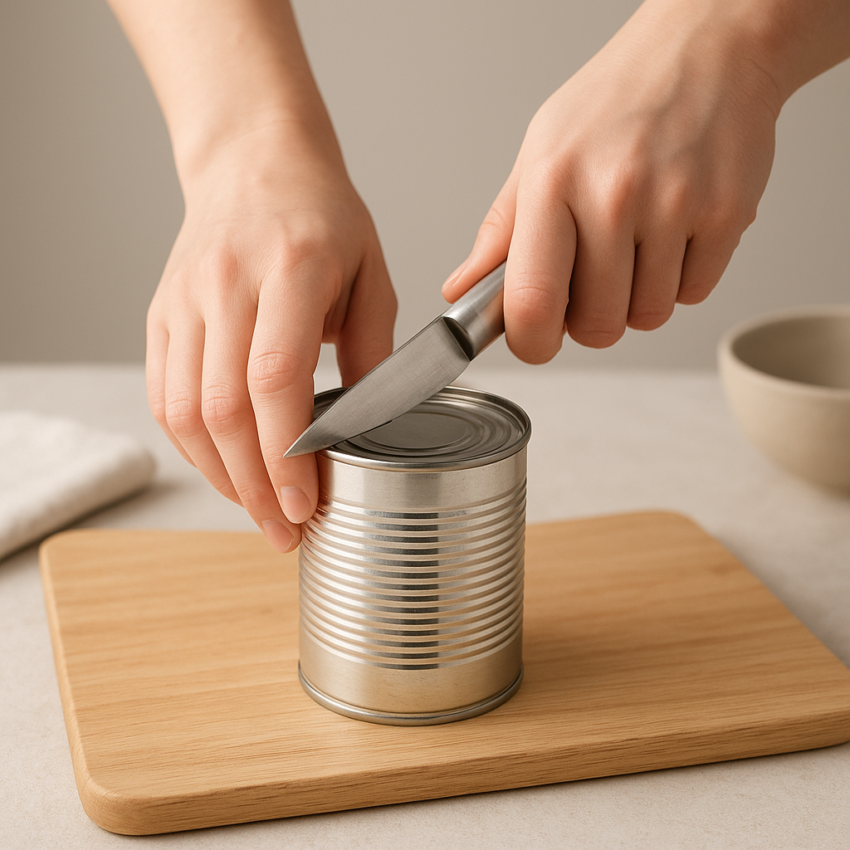
Using a Chef’s Knife
If you’re confident with a kitchen knife, it can serve as a tool to open a can. Here’s how:
- Place the can on a stable, flat surface.
- Use the heel of the knife—where the blade meets the handle—to apply pressure to the lip of the can.
- Start by making a small indentation through a controlled stabbing motion, taking care to avoid slipping.
- Once a perforation is formed, work the blade around the lid to cut through gradually.
Using a Spoon and Knife Combination
In some cases, combining tools makes the task easier. Use this method:
- Start the process using the back-and-forth motion of a spoon until you create a small opening.
- Insert a small paring knife into the opening created by the spoon.
- Carefully leverage the knife to gradually cut or pry open the remainder of the lid.
Using a Concrete Surface
If you’re outdoors or have no utensils available, a rough surface can be your ally:
- Locate a flat, abrasive surface like concrete.
- Turn the can upside-down and rub the top over the surface in a back-and-forth motion.
- Continue until the seal is visibly wearing thin, then use a blunt object to press the edges.
- Carefully peel the lid back with your hands or a cloth, taking care of sharp edges.
For more ingenious home improvement and survival tips, check out our guide on resurfacing a concrete driveway.
Using the Manual Can Breaker Technique
If you have strong hands, try this ancient technique:
- Hold the can in one hand, with the seam facing upward.
- Using a spoon or flat tool, press down hard on a point of the seam until it’s dented.
- Continue to apply pressure around the can’s rim, using the same dragging motion as before, until it opens.
These creative solutions to how to open a can without a can opener can be lifesavers in unexpected situations. Whether you’re facing a kitchen emergency or roughing it outdoors, these techniques empower you to get the job done. For a more detailed understanding of these and other similar life hacks, you might want to explore this comprehensive guide from Wikipedia.
- Using a spoon can effectively open a can with proper technique.
- Knife methods require caution but can be efficient.
- Concrete surfaces offer a natural can-breaking option outdoors.
- Practice makes perfect—try these methods safely beforehand.
- When in doubt, look for substitute tools that minimize injury risk.
FAQs
What is the safest way to open a can without a can opener?
The spoon method is considered one of the safest ways, as it minimizes the risk of cutting yourself compared to using sharp implements.
Can any knife be used to open cans?
While any sturdy knife might work, a chef’s knife or similarly robust blade is recommended to ensure control and reduce the risk of the knife slipping.
Is it possible to open a can using just bare hands?
Opening a can with bare hands is not recommended, as it can lead to injury. It’s best to use a tool or a rough surface.
Are there other tools that can open a can without a can opener?
In addition to spoons and knives, you could use other hard, flat tools such as metal rods or even a sturdy ring pull if properly applied.
Can frequent practice with these techniques replace the need for a can opener?
While these methods are valuable in a pinch, they shouldn’t replace a can opener for everyday use due to their potential for injury and time consumption.