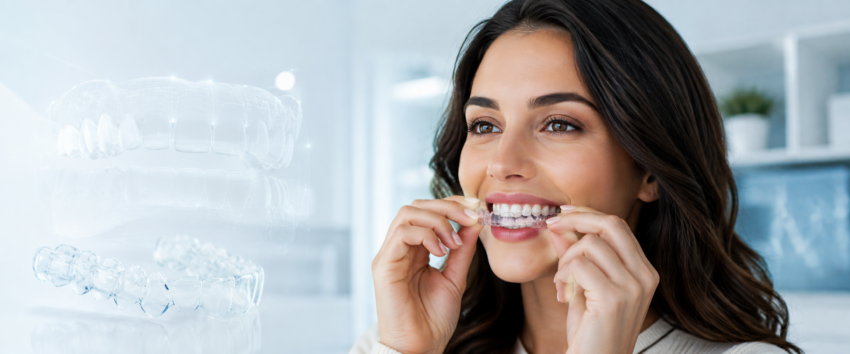
Invisalign treatment has come a long way from simply straightening mildly crowded teeth. Today, the system is designed to handle a much wider range of orthodontic problems, including bite correction, expansion, tooth rotation, and more complex tooth movements.
The biggest improvements aren’t just in the clear aligners themselves. Invisalign has become a more complete digital orthodontic system, combining advanced treatment planning, customized attachments, 3D-printed components, facial simulations, and remote monitoring.
More Precise Attachments
Attachments are small, tooth-colored shapes bonded to selected teeth to help Invisalign aligners apply the right amount of force in the right direction.
Newer attachment technology focuses on improving the accuracy of shape and placement. More precise attachments help the aligners grip teeth better and improve control during difficult movements such as rotation, extrusion, intrusion, and root positioning. Better placement also helps the actual treatment track more closely with the digital plan an orthodontist designs at the outset — reducing the gap between “what was planned” and “what actually happens” in the mouth.
Smarter Integration of Elastics
Some Invisalign patients need orthodontic elastics to correct bite problems such as an overbite, underbite, or certain jaw relationships.
The Invisalign treatment-planning system can now incorporate the location and type of elastic buttons directly into the digital plan from the start, rather than adding them as an afterthought. This lets an orthodontist plan aligners, attachments, buttons, and elastics as one coordinated system instead of separate pieces bolted together mid-treatment. For patients who need both alignment and bite correction, this coordination can make Invisalign a more viable — and more predictable — option than it once was.
Customized Aligner Trimlines
The edge of an Invisalign aligner near the gumline is called the trimline. New customization options let orthodontists adjust the trimline based on a patient’s teeth, gum condition, and treatment goals.
Different trimline designs can improve aligner retention in cases involving short clinical crowns, erupting teeth, or gum recession, and in some cases can reduce how many attachments are needed. It’s a small-sounding detail, but it gives doctors another lever for personalizing treatment instead of applying the same aligner design to every patient regardless of their anatomy.
Invisalign Palatal Expansion
Invisalign technology is also expanding beyond traditional clear aligners. The Invisalign Palatal Expander is a digitally designed, 3D-printed appliance intended to widen the upper jaw in suitable growing patients. Newer designs can incorporate hooks for orthodontic elastics, giving orthodontists more options for patients who need both expansion and bite correction in the same phase of treatment.
For selected younger patients, this digital approach may offer an alternative to some traditional metal expansion appliances. That said, the right expansion method still depends on the patient’s age, jaw development, bite, and skeletal needs — this is very much a case-by-case clinical decision, not a one-size-fits-all upgrade.
Better Digital Treatment Planning with ClinCheck
ClinCheck is the digital treatment-planning software used to design Invisalign treatment. Modern versions give orthodontists increasingly detailed control over tooth movement, bite relationships, attachments, elastics, and other treatment variables.
Rather than simply showing teeth moving from crooked to straight, the software allows a doctor to plan individual stages of treatment and evaluate how each movement may affect the overall bite. That staged, bite-aware planning is especially valuable in complicated cases — it’s the difference between “moving teeth” and “moving teeth in the right sequence so the bite lands correctly at the end.”
3D Facial and Smile Simulation
Invisalign planning tools are also becoming more visual. Simulation technology can show patients how planned tooth movements may affect their smile, lips, and facial appearance — useful for discussing treatment goals and understanding why certain movements, extractions, or expansions are being recommended.
Patients should keep in mind that these simulations are predictions, not guarantees. Biology doesn’t always follow the digital model exactly, which is part of why treatment plans get adjusted along the way.
A Growing Role for Artificial Intelligence
AI-assisted systems can help analyze dental scans, identify tooth positions, measure movements, support treatment planning, and monitor progress between appointments — allowing orthodontic teams to review large amounts of information more efficiently.
AI doesn’t replace the orthodontist, though. Successful treatment still depends on accurate diagnosis, sound treatment planning, an understanding of tooth and jaw biomechanics, and hands-on clinical supervision throughout the process.
Remote Monitoring Between Appointments
Patients can often send photos or digital scans of their teeth between office visits, and software helps the orthodontic team check whether aligners are fitting correctly and whether treatment is progressing as expected.
This can reduce the number of routine in-office visits for some patients and help catch problems — poor fit, a broken attachment, inadequate wear — before the next scheduled appointment. Regular professional supervision is still part of the process; remote monitoring supplements office visits rather than replacing them entirely.
Invisalign Can Now Treat More Complex Cases
Clear aligners were once recommended mainly for mild crowding and spacing. Today, experienced orthodontists use Invisalign for a much broader range of problems, including:
- Moderate to severe crowding
- Tooth rotations
- Deep bites, open bites, and crossbites
- Some overbite and underbite corrections
- Arch expansion
- Selected extraction cases
- Treatment involving orthodontic elastics
Invisalign isn’t automatically the right choice for every patient, though. Certain complex tooth movements, significant skeletal problems, extensive root movement, or difficult extraction cases may still be more predictable with braces or a combination of braces and aligners.
Refinements Are a Normal Part of Treatment
A common misconception is that the first set of aligners will complete the entire treatment. In reality, many patients need refinements — additional sets of aligners created after the orthodontist evaluates how the teeth responded to the original plan.
Refinements are typically needed because some teeth don’t move exactly as predicted, or because the orthodontist wants to fine-tune the final bite or alignment. Needing a refinement doesn’t mean treatment failed; it’s often just part of getting to an accurate final result.
The Orthodontist Still Matters More Than the Technology
Invisalign’s technology keeps getting more sophisticated, but the appliance is only one part of a successful outcome. Two patients can receive Invisalign and get very different results depending on how their cases were diagnosed and planned.
An experienced provider evaluates far more than whether teeth look crooked — bite, jaw relationships, gum health, bone support, tooth roots, facial profile, and long-term stability all factor into the plan. Digital tools can make Invisalign more precise, but clinical judgment is still what makes it work.
Final Thoughts
Invisalign has evolved from a simple clear-aligner system into a highly customized digital orthodontic platform. More precise attachments, integrated elastics, customized trimlines, palatal expansion, advanced ClinCheck planning, facial simulations, AI, and remote monitoring are giving orthodontists more tools to personalize care — which means Invisalign may now suit patients who wouldn’t have been considered good candidates in the past.
Still, technology alone doesn’t determine the outcome. A thorough orthodontic evaluation is the best way to find out whether Invisalign can safely and predictably achieve the result you want.